
Your ad here
Reach the executives, lawyers and operators shaping the industry.
Advertise with usConcept, script, casting, production design, camera, sound, edit, colour and delivery: the stages every professional production passes through, and the decisions that decide its quality.
Every film, at any budget, passes through the same sequence of stages. Understanding that sequence is what allows a small team to produce work that looks like a much larger one, because each stage can be done well or badly regardless of money.
Stage one: concept and script
The concept is the reason the film exists. The script, however short, is how that reason survives contact with a schedule. Even a two-page treatment prevents the most common production failure: arriving on set without a clear idea of what the finished piece should feel like.
The script stage is also where boundaries are defined. Scene scope, limits and the check-in plan belong in the document that everyone reads, not in a conversation two people remember.
Stage two: producing
The producer turns intention into logistics: budget, schedule, crew, locations, paperwork, clearances and contingency. On small productions the director often does this too, which is why small productions are exhausting.
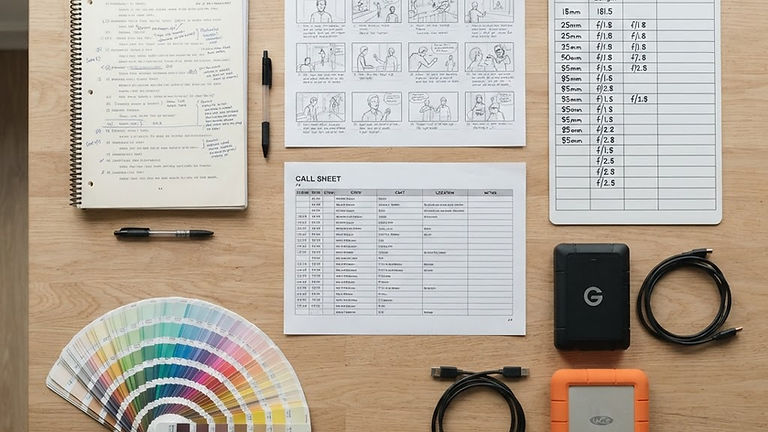
The most valuable producing habit is a realistic call sheet with named owners for every task. Ambiguity about who is doing what is the single most expensive line item on any shoot.
Stage three: casting and pre-production
Casting determines chemistry, and chemistry determines whether the film works. Pre-production is where the design, wardrobe, makeup plan and shot list are agreed, and where the camera department decides how the story will be covered.
This stage is where a production can still be changed cheaply. After it, every decision costs money.
Stage four: the shoot
A well-planned day is quiet and dull, which is exactly what you want. The director states intent, the camera department executes it, sound captures a clean record, makeup maintains continuity, and the producer protects the schedule.
The most underrated role on set is the script supervisor or the person performing that function: checking that coverage is complete, that eyelines match, and that nothing on the shot list was missed in the rush.
Stage five: post-production
Post is where footage becomes a film, and where small studios now spend much of their budget. Editing establishes rhythm and selects performances. Sound design and mixing make the space feel real. Colour correction makes the whole piece coherent.
The most common post mistake is starting the edit without an assembly plan. An editor who knows what the film is about cuts faster and better than one who is asked to find out.


Your ad here
Reach the executives, lawyers and operators shaping the industry.
Advertise with usStage six: delivery and distribution
Delivery is not a technicality. Correct formats, correct watermarks, rights-managed links, metadata and a documented licensing trail protect the work and the people in it.
Decide before the shoot who holds the masters, for how long, and in what formats, and write it down. This is the item most often forgotten and most often disputed later.
Credit conventions worth adopting
Name every department head in the credits and on the release page. Link them to their directory profiles where they exist. It costs nothing, it builds the crew's careers, and it makes your production look like a company that people want to work with again.
Where small productions break
Small productions rarely fail because of a single catastrophe. They fail at handovers: the shot list that nobody read, the media card that was never offloaded, the sound record that was not monitored, the delivery spec that was discovered on release day.
Each of those is preventable with one page of documentation and one named owner. That is the entire argument for process in a business that often romanticises improvisation.
The second common failure is scope. A two-day shoot written as though it were four will produce a film that is 70 percent complete and cannot be released. Writing for the budget and the calendar you actually have is a creative discipline, and it produces better work than ambition without arithmetic.
A one-page workflow
Before the shoot, write a single page with six headings: concept, scope and boundaries, shot list, schedule with owners, equipment and storage, delivery format. Circulate it to everyone, and bring printed copies on the day.
During the shoot, log every card and back it up before anyone leaves. After the shoot, confirm receipt of footage in writing and agree the edit timeline.
That page costs an hour and prevents most of the arguments that follow a difficult shoot. It also makes a production legible to a bank, an insurer or a new collaborator, which is how a small operation starts to look like a company.
The same principle applies to credits. A production that names its department heads and links to their work is easier to staff next time, because the crew can see that the credit is real and that the company treats people as collaborators rather than as line items.
Practical takeaways
-
Write a treatment even if the film is short; it prevents the most expensive mistakes.
-
Put scene scope and boundaries in the document everyone reads.
-
Use a call sheet with a named owner for every task.
-
Cover the scene: master, mid, inserts, and a clean record of sound.
-
Plan the edit before the shoot, and budget for sound and colour.
-
Agree master-file custody and licensing in writing, and credit every department.
Attribution: This story draws on the public sources linked at the end of the article.
About this byline
The XXXPress Editorial Desk
The Industry Business Desk covers the money side of the business: payment processing, insurance, lending, consolidation, licensing, retail economics and the operating decisions that decide whether a studio, club or platform survives its next downturn.
Reported and written by XXXPress editorial staff. Outside sources are attributed and linked; no sentence is copied from another publication.
Fact-checked by the desk before publication
Sources and further reading
Original reporting by The XXXPress. The links below are attributed to their publishers for verification and context; we do not host or republish their articles.
- Cal/OSHA: adult film industry safety guidancedir.ca.gov
- U.S. Copyright Office: copyright basicscopyright.gov
- Free Speech Coalition: industry resourcesfreespeechcoalition.com
#production #pre-production #post-production #crew #workflow


Spotlight XXXPress: Steven Hirsch — The Visionary Who Helped Build Modern Adult Entertainment
Business & Finance · 8 min read